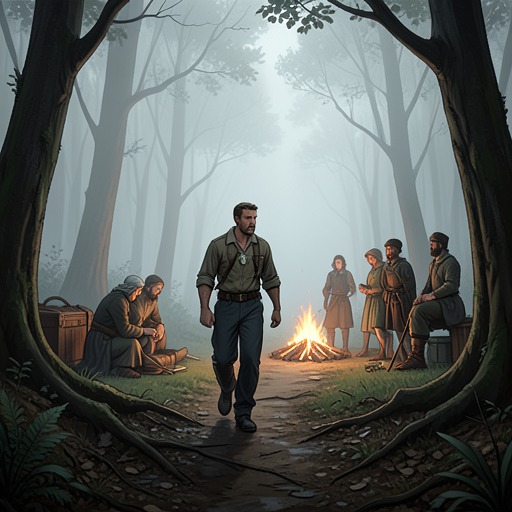
Jaromir and Rhosyn’s betrothal arrangement
The Ballad of the Last DragonJaromir and Rhosyn’s betrothal arrangement is a nominal, duty-bound marriage agreement whose real purpose is to preserve a widow’s home and her daughters’ future under Kalinia’s exclusionary inheritance law. It binds Jaromir to Rhosyn through family responsibility rather than love, becomes the central obstacle to his relationship with Sylvaine Abelan, and finally collapses when Jaromir chooses not to marry Rhosyn after acknowledging what has developed between him and Sylvaine.
Purpose and Legal Foundation
The arrangement originates in the precarious position created by Damir’s death. Jaromir explains that he offered Rhosyn his hand in title only so she would be protected if he died. Damir’s land, farm, and house had passed to Jaromir, not to Rhosyn; under Kalinia’s local inheritance regime, she had no secure claim to the home where she was raising her daughters. Rhosyn had repeatedly petitioned for a way around the law, including a binding stewardship contract and an attempt to buy out the deed, but the magistrate rejected every effort.
Jaromir therefore treats the betrothal as an obligation to his family. He has promised that Rhosyn will not lose Damir’s home, and his sense of duty is intensified by the memory of his brother’s death. The agreement is not presented as a conventional courtship. It is a legal and familial safeguard devised within a system that allows the town to absorb an inheritance when no suitable male heir exists, leaving a widow and children vulnerable precisely when they most need stability.
The arrangement also exposes a conflict between overlapping authorities. Queen Dhara’s inclusive land and title ownership policies represent a broader reforming principle, while Kalinia’s magistrate continues to enforce an archaic male-heir rule. Rhosyn’s domestic security depends not only on Jaromir’s promise but on whether local power will recognize her right to remain in her own home. The ornate office and self-protective reluctance of Magistrate William M. Ridion make the legal structure appear less like neutral administration than a system protecting those who profit from other people’s vulnerability.
Conditions of the Proposed Union
Rhosyn makes clear that she has no interest in marrying Jaromir for its own sake. Damir built the house, and its familiar details—the creak of a floorboard and the nail in the third step—preserve his presence for her. The land also carries the history of several generations and the future she and Damir imagined for their daughters. Losing it would mean losing the last material place where her family’s life remains continuous with his.
The planned union is described as a winter marriage, only a few months away. Until then, Jaromir and Rhosyn have agreed to live as though they are unattached, each free to seek pleasure elsewhere; after the ceremony, however, they would take the marriage rites seriously. Their arrangement is thus unusually explicit about its separation between legal commitment and romantic feeling. They have known each other all their lives, and Rhosyn has regarded Jaromir primarily as Damir’s brother and her friend. Friendship and respect exist between them, but love is only a possibility she once imagined might grow from time and circumstance.
Jaromir’s route into Aeron Fowler’s expedition reinforces the practical nature of the agreement. He had first been hired to train Aeron with a sword, and Aeron paid him session by session so that Jaromir could send money to his betrothed. When Jaromir saw Aeron’s notice recruiting companions, he initially declined, then changed his mind because the expedition offered a quick way to earn enough money to advance his obligations. The betrothal therefore shapes even his apparently adventurous choices: the road is also a financial route toward marriage and the protection of Rhosyn’s household.
Conflict with Sylvaine Abelan
The arrangement becomes a source of pain once Jaromir and Sylvaine’s intimacy turns their relationship into something neither can dismiss as temporary. Sylvaine’s anger is directed not merely at the fact of another woman but at the prospect of becoming a hidden substitute: someone waiting for Jaromir to leave his wife whenever desire called him away. The nominal nature of his betrothal does not make its emotional consequences nominal. From Sylvaine’s perspective, a title-only marriage could still leave her with secrecy, partial devotion, and no recognized place in Jaromir’s life.
Jaromir’s explanation weakens Sylvaine’s attempt to reduce the arrangement to a false promise. He had not entered it casually, nor does he claim that Rhosyn was merely an unwanted obstacle. He assumed responsibility because Rhosyn and her daughters could lose their home, and because the inheritance would otherwise pass to the town magistrate if Jaromir died without heirs. His reasoning is ethically serious even while it fails to answer Sylvaine’s demand for a duty toward her. The conflict is therefore not between sincerity and deception alone; it is between two legitimate claims that cannot easily occupy the same future.
Rhosyn later confirms that the emotional triangle is less symmetrical than Sylvaine fears. She does not want Jaromir as a husband, though she has accepted the arrangement as the price of protecting her daughters’ home. Her candor reveals that the coming wedding has filled her with dread, not anticipation. She and Jaromir have friendship and respect, but no established romantic bond. This disclosure does not erase Sylvaine’s pain, because the winter union remains real as a social and legal threat, yet it changes the meaning of Jaromir’s promise: he is not choosing between two loves so much as trying to reconcile familial duty with a love he had not expected.
Collapse and Consequences
Jaromir finally states that he will not marry Rhosyn, though he does not pretend that this decision solves the underlying problem. He offers Rhosyn his share of the hoard, judging it sufficient to provide her and her nieces with a comfortable life somewhere. He will not settle into her household, work her lands, or remain tied to the property through an altered domestic arrangement. Instead, after persuading her to accept the gold, he plans to sign the deed over to the magistrate or sell it.
That choice preserves Rhosyn’s immediate financial security while surrendering the home that had mattered to her and carried Damir’s memory. Jaromir’s refusal to live there is connected to his inability to inhabit a place filled with his brother’s echoes and to his knowledge that abandoning the property means allowing Rhosyn and her daughters to lose their last piece of Damir. His proposed resolution consequently feels less like freedom than penance: he gives away the inheritance, the house, and his own material future without claiming a compensating home for himself.
The arrangement’s legal crisis is ultimately confronted by Sylvaine and Rhosyn together. Sylvaine approaches Magistrate William M. Ridion after verifying the situation with Rhosyn, and Rhosyn herself makes the demand. She requires him to discard the antiquated inheritance law, prevent people from being expelled after family tragedy, serve the vulnerable rather than profit from them, and enact Queen Dhara’s inclusive policies so that anyone can build a life in Kalinia. Sylvaine arrives with a prepared legislative document and offers to witness Ridion’s signature and official seal, turning the women’s understanding of the law into a direct political intervention.
Meaning of the Arrangement
Jaromir and Rhosyn’s betrothal arrangement dramatizes the difference between a promise made from love and one made from responsibility. Jaromir’s commitment is morally intelligible because it protects people he regards as family, yet its structure also asks every participant to accept deprivation: Rhosyn must risk losing her home, Jaromir must postpone his own desires, and Sylvaine must endure the possibility of being excluded from the future she wants. The arrangement produces conflict because private virtue cannot fully compensate for an unjust public rule.
Its collapse does not simply clear the path for Jaromir and Sylvaine. It exposes the cost of treating marriage as an instrument of inheritance protection and shows why individual sacrifice cannot replace legal reform. Rhosyn’s claim to her home, Jaromir’s promise to his dead brother’s family, and Sylvaine’s demand for an acknowledged place in Jaromir’s life all become part of the same struggle over who is allowed to possess land, form a household, and define family. The betrothal begins as a protective fiction of marriage, but its consequences reveal a larger truth: when law makes security depend on a male heir, even an arrangement founded on loyalty can become a form of displacement.